Environment | Community Media | Responsible Journalism
______________
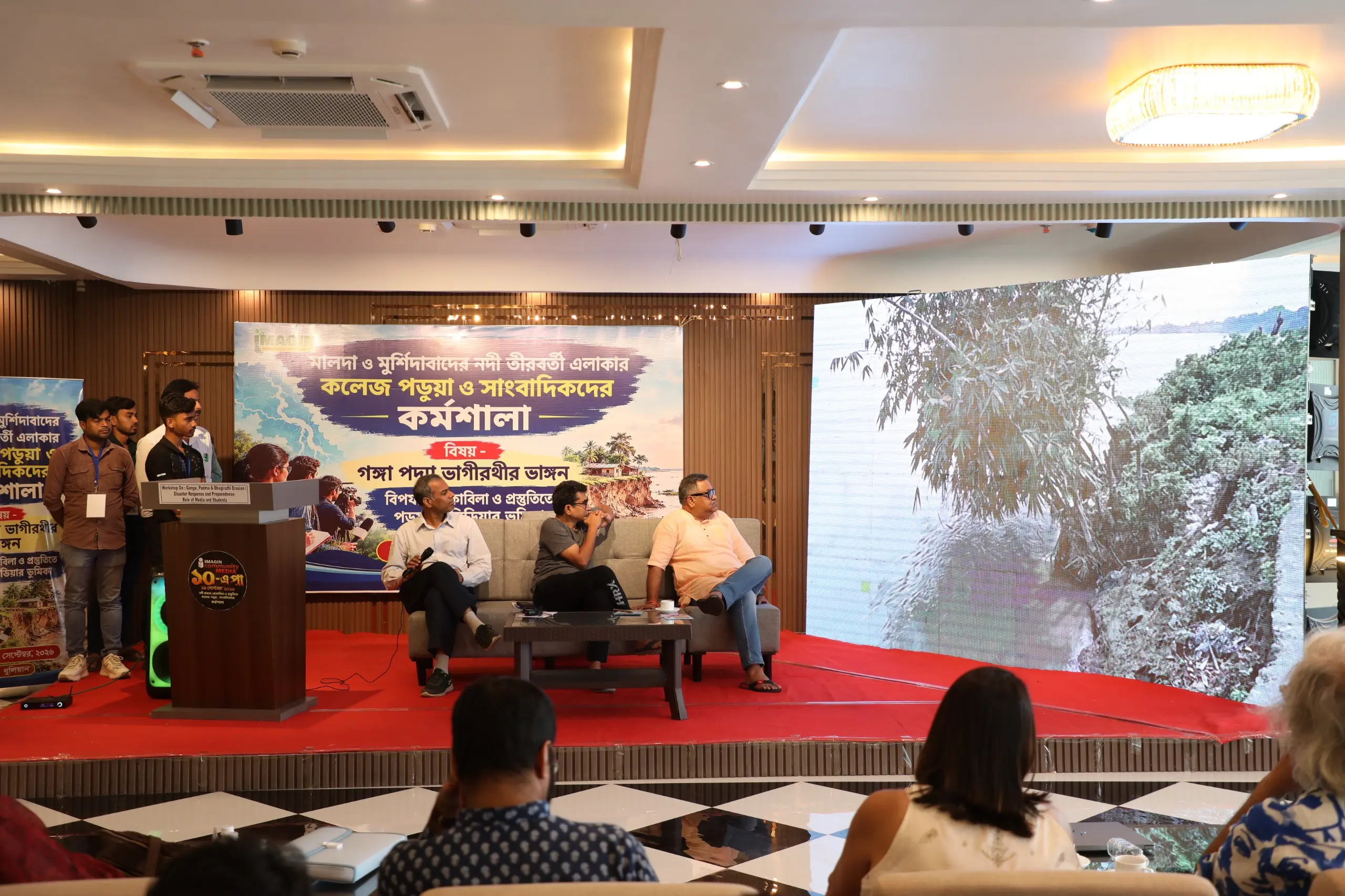
Sometimes a river shifts quietly. Sometimes it swallows homes, farmland, roads and familiar landmarks overnight. For thousands of families in Murshidabad and Malda, riverbank erosion is not a distant natural hazard. It is a daily fear.
What causes the erosion? What are the sustainable ways to respond? And how can the stories of the people it displaces reach the wider public responsibly?
To explore these questions, IMAGIN organised a two-day workshop in Dhulian, Murshidabad, on 19 and 20 September 2026 . It brought together 35 journalists and college students from the riverside areas of Malda and Murshidabad. The workshop marks the start of a year-long programme of understanding, awareness and action on the erosion crisis along the Ganga, Padma and Bhagirathi.
Honouring Those Who Reported the Erosion
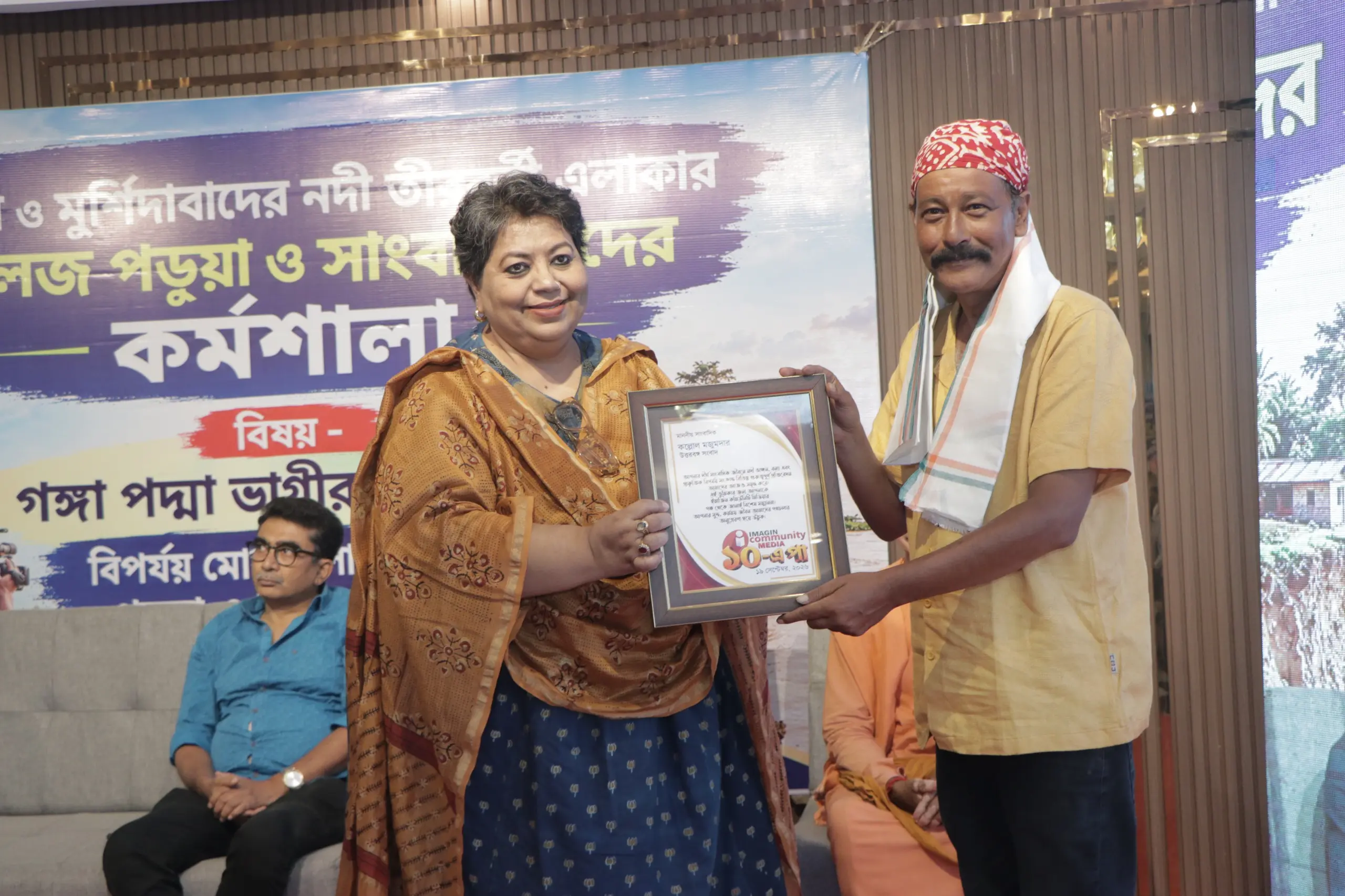
The first day opened with a tribute to six journalists who have brought the erosion of the Ganga, Padma and Bhagirathi to public attention for years: Pradip Dey (Ajkaal), Pranamoy Brahmachari (Asian Age), Biman Hazra (Anandabazar Patrika), Kallol Majumdar (Uttarbanga Sambad), Abhijit Chowdhury (Ajkaal), Alamgir Hossain (The Telegraph).
They shared experiences from the field: shifting river courses, lost homes, livelihood crises, the role of administration, and the importance of ensuring that the voices of affected communities are heard accurately in the media. Pradip Dey described erosion as a major crisis for both districts and spoke of its deep connection with people’s lives and livelihoods.
Inaugural Session
The inaugural programme was attended by: Swami Madhuranandaji Maharaj, Farakka Bharat Sevashram, Sucharita Bardhan, Communication Specialist, UNICEF, Prasenjit Boxi, Consulting Editor, Prasar Bharati, Dr. Biswajit Roy Chowdhury, river expert and lead trainer
Training in Responsible Journalism
Sucharita Bardhan led a detailed session on responsible journalism. It covered how a report can be more fact-based, humane and relevant, and how people’s voices and data can be presented accurately. Participants were then divided into teams and given assignments, so the discussion would connect to real-life reporting.
From the Classroom to the Riverbank
On the second morning, participants left the hall with notebooks, cameras and pens to visit erosion-affected areas. They saw the visible damage, spoke to residents, and observed the daily struggle between people and the river. Back at the venue, the teams turned their field experience into reports. Erosion was not only to be seen but understood, through listening, verifying and telling the story with evidence.
Working With the River, Not Against It
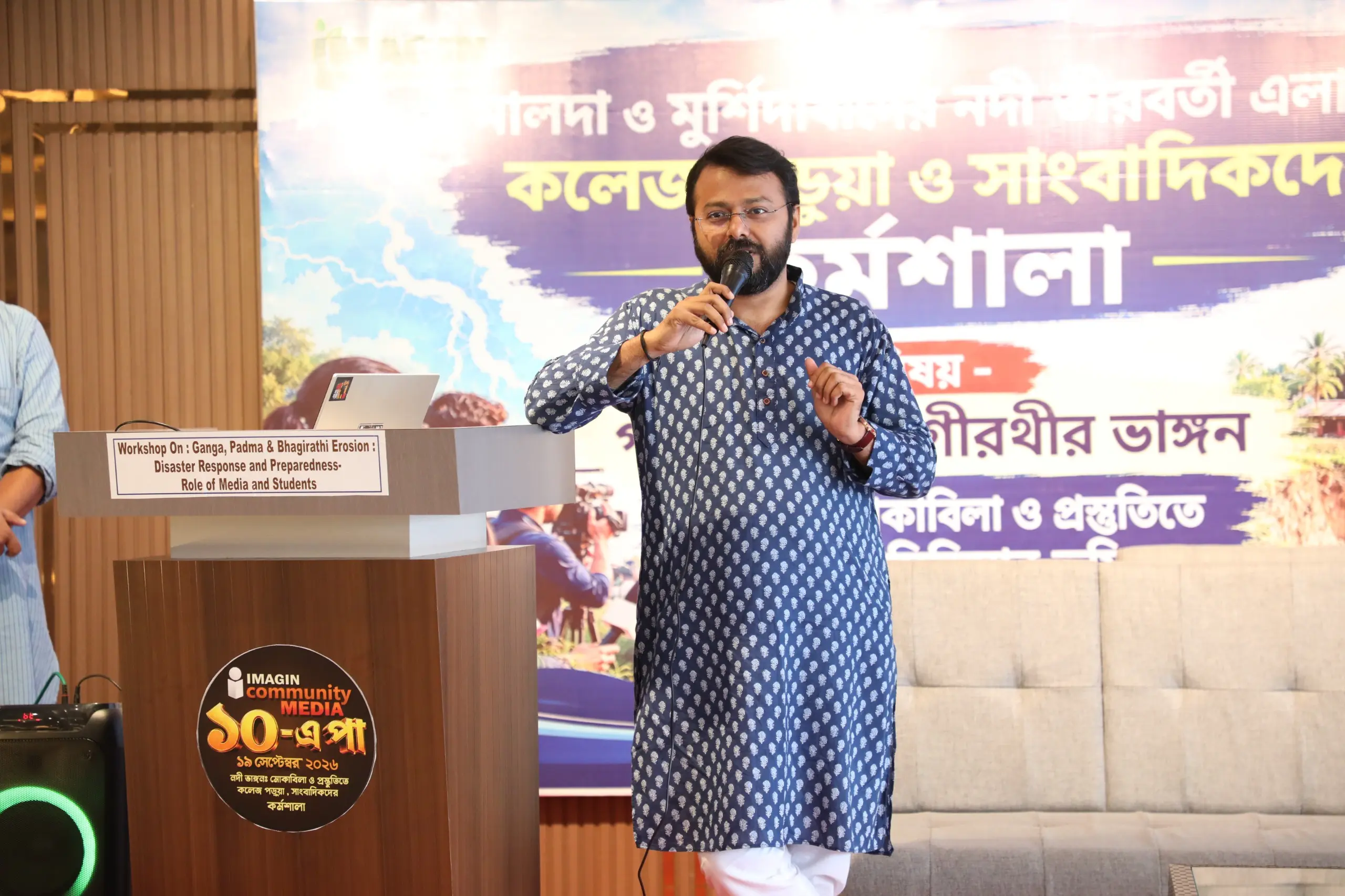
Lead trainer Dr. Biswajit Roy Chowdhury emphasised understanding the river’s own course and character. He discussed river-friendly approaches to flood and erosion management, respect for natural river movement, and the need for early warning systems. His message was that disaster management should not rest on controlling the river alone, but on understanding its behaviour and working in harmony with it.
Erosion Is Also a Livelihood Crisis
Losing land and homes also means losing a means of living. A session on alternative livelihoods featured Unmesh Mitra, Employment Officer-in-Charge, Malda, and environmentalist, and Nayan Sarkar, teacher and photographer. Participants discussed the potential of eco-friendly tourism built around rivers, chars (river islands) and birdlife, asking how the river that takes homes and land could also support new livelihoods.
Reports Reviewed by Media Professionals
In the final session, participants presented their reports, written for both print and digital platforms. A panel reviewed them:
• Dhrubajyoti Pramanik, Managing Editor, Network18 Media
• Prasenjit Boxi, Consulting Editor, Prasar Bharati
• Amitava Das, Communication Consultant, UNICEF
Sucharita Bardhan also joined the discussion. Feedback covered topic selection, use of data, writing, presentation for digital platforms, and technical aspects. The central lesson was that an erosion story should go beyond statistics of loss to reflect lives, environment, administration and the questions of the future.
Throughout the two days, participants could view an exhibition of paintings on riverbank erosion by artist Mizanur Khan
What Comes Next
The workshop is the beginning of a long engagement. Over the next year, IMAGIN will carry out activities in phases to:
• Gather more information and data on riverbank erosion
• Document and share the experiences of affected communities
• Strengthen responsible journalism and public awareness
• Continue discussions on practical, sustainable solutions
IMAGIN believes that lasting solutions begin with accurate information, informed storytelling and community participation. Through this initiative, we aim to help the people living along the Ganga, Padma and Bhagirathi find answers to a long-standing question: where is the solution to riverbank erosion?
